Preventing Building Collapse
Overview
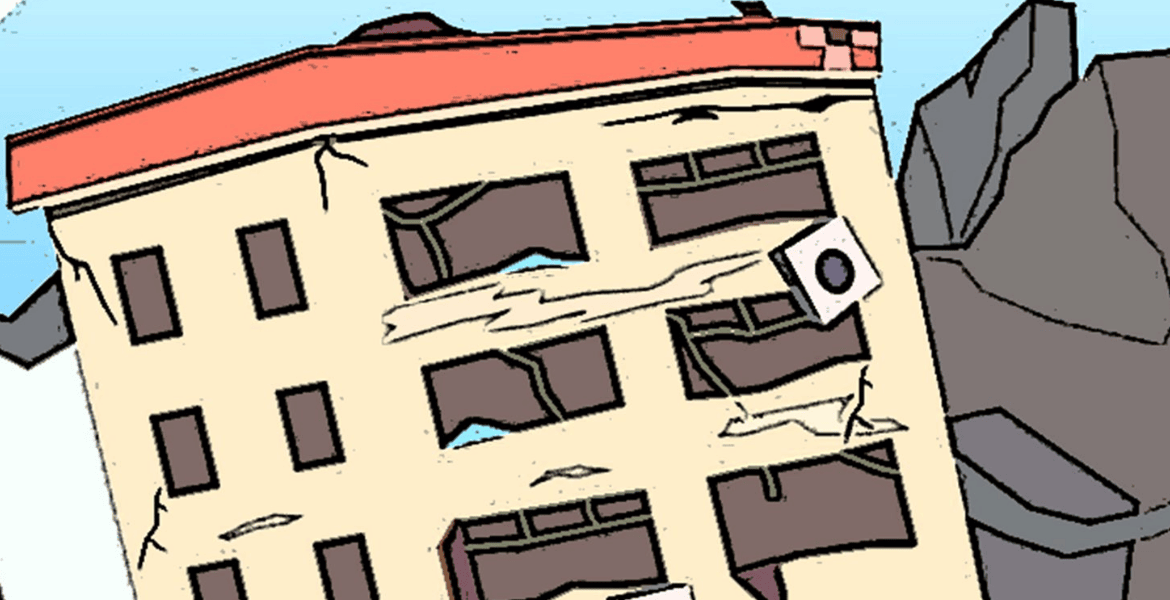
Buildings collapse in Nigeria on a regular basis. Old buildings, recently finished buildings, and mostly buildings under construction… they all come down in Nigeria.
The aftermath is the same: outrage; blame; half-hearted investigations; petty arrests; increased legislation; blind over-enthusiasm from the authorities for the next few weeks; and then back to normal… until the next building collapse. The unfortunate truth is this: until the core problems are identified and addressed, not a single difference will be made.
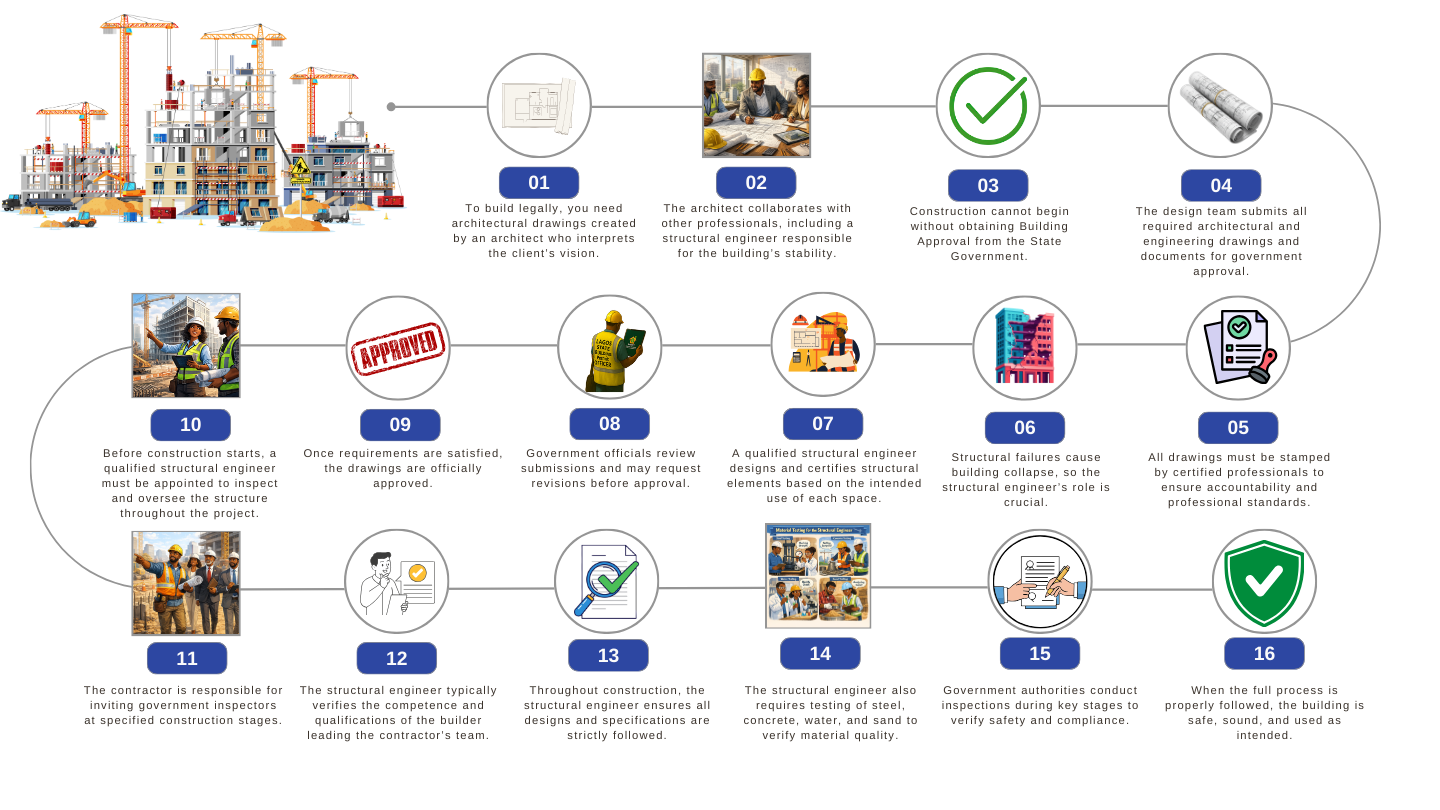
A building collapsing is as a result of a structural failure of the building. But before we speak about why a building has come down, let us discuss how a building is supposed to come up… in Lagos.
Summary of Building Construction Process
The process described below works in Nigeria. If this process is followed through there will be no problems. But the process described below is only followed through in a tiny fraction of the buildings which are erected.
Key Issues
Click to expand
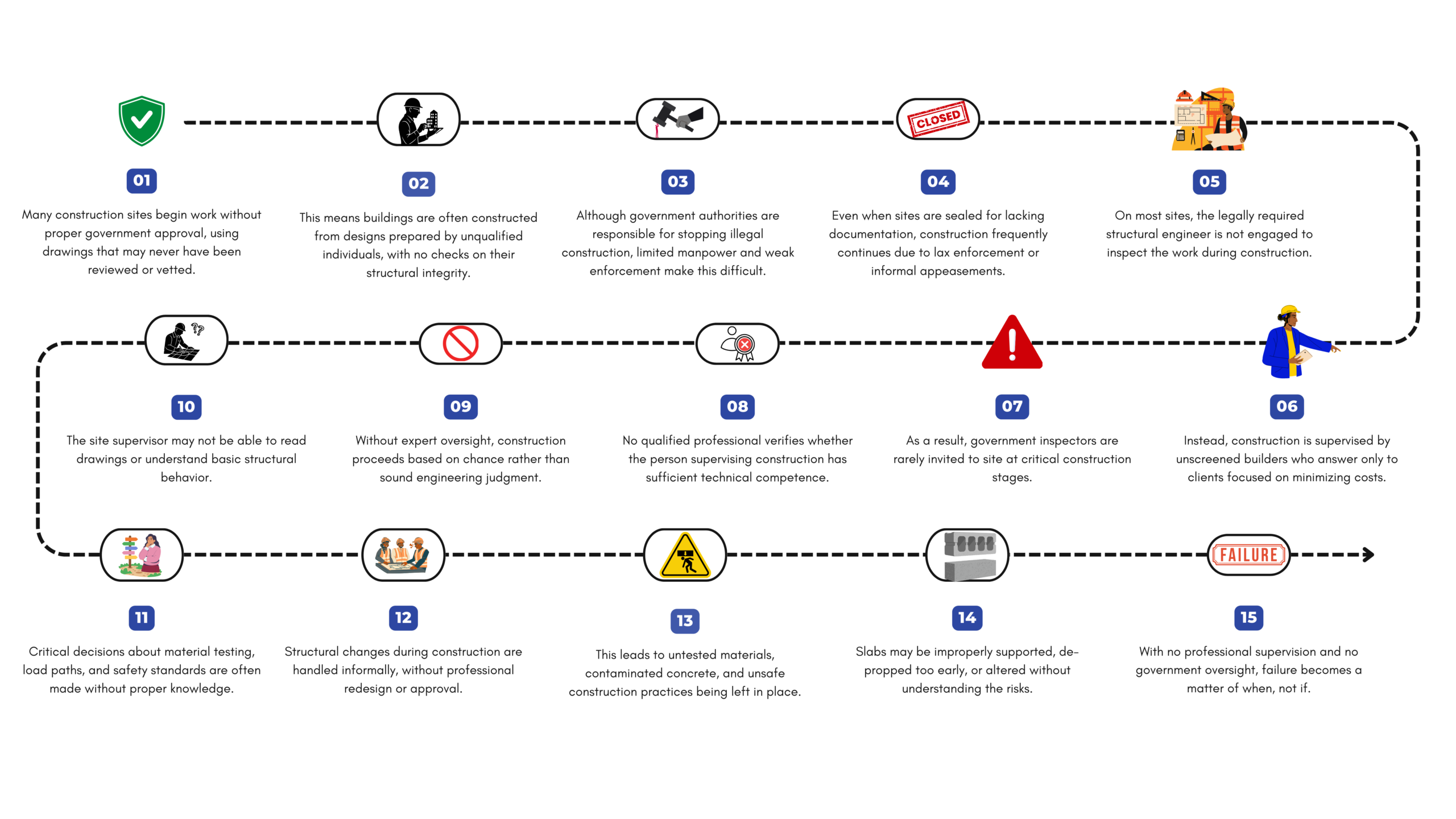
- A lot of construction work commences on site without the proper approval documentation being obtained. Meaning that contractors start work on site with drawings which could have been prepared by absolutely anybody. Drawings which have NOT been vetted by anybody. This leaves an obvious problem with the basic integrity of what is being built.
- Government authorities are there to counter illegal structures from being erected. However there are not enough trained personnel in the government departments to track illegal constructions. In cases where construction sites have been sealed by the authorities because of a lack of documentation, it is very common to see work proceeding regardless because the enforcement is slack, and in some cases appeasements have been made.
- On site, very rarely is a qualified structural engineer engaged to inspect the construction process as is the legal requirement. Work on site is supervised by unscreened builders who are accountable only to their clients – clients whose primary interest is to deliver the cheapest building possible.
- The offshoot is thus:
- Question 1: Nobody invites the government authorities to site as and when necessary during construction;
- Question 2: Nobody has vetted the person in charge of the construction. Now, the emphasis on the skillset of this individual isn’t necessarily an academic one. But typically a consultant structural engineer would want to know that whoever is supervising construction on site has a well-rounded construction knowledge. Without a consultant structural engineer to vet the competence of the builder and inspect construction work as it is ongoing, sheer luck and not providence becomes the driver of the process:
- Question 3: Can the person read drawings? Does the person understand basic structural principles – which members are in tension and which are in compression? Does the person know when to test materials?
- Question 4: Does the person know best safety standards? Does the person know how to prop a suspended slab to be cast? Does the person know how long a suspended slab is meant to remain propped after casting? Building designs change all the time during construction – does the person know how to make modifications to structural elements? Etc.
- Imagine if the answers to all the questions asked above is “no”? Buildings constructed with no reference to structural drawings; Untested materials used; modifications poorly dealt with; impurities in concrete; poorly done and dangerous work allowed to remain because it is too expensive to modify; slabs de-propped too soon; slabs not propped properly; no input from the government.
A combination of one or all of the above plague majority of the ongoing construction projects in Nigeria. The number of collapses during construction is astounding and in truth only a fraction of these stories actually make headlines.
Proposed Solution
Landlords and government authorities have the duty to ensure that a building is used for what it was designed to be used for. See note 7 above: A structural engineer will design a building to the parameters defined by the client and architect. He will leave a lot of tolerance but tolerance can only get you so far. A domestic residence is built, if in a few years down the line the building changes hands and all of a sudden the new client wishes to use the building as a data center and start storing servers in a place designed for beds – problems will occur. The government officials need to realize that grating permission to change the use-class of a building has structural repercussions on the building.
Concrete framed buildings typically show signs of impending failure before they completely collapse – a twisted column here; a beam deflecting there. The occupiers of these building and the general public at large must be informed of who to speak to when these signs of impending failure become evident.
Possible Ways to Reduce Incidences of Buildings Collapsing
Click to expand
- 1. Properly train and recruit many more government officials to the building control departments.
- 2. Properly train and recruit many more builders & civil & structural engineers than the system currently churns out.
- 3. Provide incentives for members of the public to notify government departments when new construction work starts, so legality of construction can be ascertained.
- 4. Budget for enforcement needs to be significantly increased.
- 5. Judiciary must be brought on board – quick prosecutions, fine and possibly jail for clients who: fail to submit drawings for approval; commence work on site without approval; do not engage licenced structural engineers to inspect construction projects.
- 6. Whistle-blower policy with incentives to catch out government officials who are open to appeasements.
- 7. Explore ways in which the private sector can come on board in the process. Using U.K. privatization of building control as a possible template.
- 8. Launch a determined drive to prosecute manufacturers and distributors of fake and sub-standard building materials in the country.
- 9. Make building’s insurance compulsory.
- 10. Insurance companies will be obligated to engage structural engineers to inspect buildings during assessment & evaluation stage.
- 11. Defects noted will be passed on to owners & government for immediate remedial works.
- 12. Building owners are less likely to shirk their repair obligations or fear defective building demolition if they know the structures are insured.
- 13. To ensure insurance remains valid, owners will be obligated to use the buildings for the purposes they were constructed, or carry out necessary upgrades if a change of use is so desired.
- 14. Sensitize the general public on who to call if building defects are observed.
- 15. Overhaul existing building control guidelines to ensure mandatory structural tests for buildings which undergo a change of use.
- 16. Professional bodies must come together to draft a coherent building code.
- 17. Extensive public relations / outreach and grass roots consultations / conversations for buildings which have to be demolished.